
'Climate change is a reality': This glacier has officially gone extinct

A South American glacier has been declared extinct due to factors including rising temperatures and decreasing snowfall, according to the Colombia Institute of Hydrology, Meteorology and Environmental Studies.
Related video above: How much climate change have we seen already in our lives?
The Cerros de la Plaza glacier in the Colombian Andes was confirmed to have disappeared in March after shrinking gradually since 2015. IDEAM, a government agency that produces and manages scientific information on Colombia’s environment, reported that the surface area of the glacier once covered an area of 5.5 square kilometers in the mid-19th century. It diminished to just 0.15 square kilometers in 2016, and from March 2016 to February 2026, Copernicus Sentinel-2 satellite images recorded the glacier’s transformation as it continued to shrink and fragment until it disappeared entirely in March 2026.
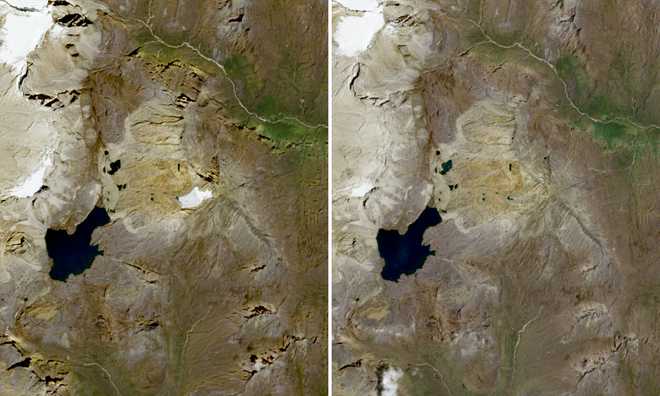
According to the National Snow and Ice Data Center, a glacier is a mass comprised of ice and snow that flows slowly over land. Across the globe, glaciers cover a total area of around 270,000 square miles.
IDEAM attributes the extinction of the Cerros de la Plaza glacier to the effects of climate change, naming increasing temperatures and decreasing rates of snowfall as contributing factors, along with its relatively low altitude, which makes it more susceptible to climatic conditions.

"The disappearance of a glacier is not an isolated event; it is the visible manifestation of a changing climate system," IDEAM said in a post on X in Spanish.
"This event sends a clear signal: climate change is a reality that is already transforming our territories," the agency added.
In a similar signal of a changing climate, the Thwaites Glacier — also known as the "Doomsday Glacier" — has been experiencing an accelerated rate of retreat over the past 40 years, according to the International Thwaites Glacier Collaboration.
The glacier was given its nickname due to the possibility that, if it were to collapse entirely, it would raise global sea levels by 65 centimeters (25 inches).
The Thwaites Glacier Basin has an area of 74,000 square miles, and the glacier's ice loss contributes approximately 4% of global sea-level rise, according to a 2019 article in the science journal Nature.

Its rapid ice loss is linked to climate and ocean changes and is predicted to continue and accelerate, says the ITGC. The amount of ice loss by the Thwaites and its neighboring glaciers has doubled over the last 30 years, reflecting the urgent need to slow widespread rates of retreat.
In a 2025 Nature article titled "Peak glacier extinction in the mid-twenty-first century," it is projected that the rate at which glaciers disappear globally will experience a sharp rise. It is expected to peak between 2041 and 2055, with up to approximately 4,000 going extinct a year.
"Our results underscore the urgency of ambitious climate policy," the article says in part. "An earlier peak in glacier extinction, as seen under low-warming scenarios ... reflects a more optimistic trajectory."
It explains, "The difference between losing 2,000 and 4,000 glaciers per year by the middle of the century is determined by near-term policies and societal decisions taken today."